
Supergirl Star Nicole Maines on Her DC Graphic Novel | Interview

Transgender actor and activist Nicole Maines played the character of Nia Nal/Dreamer, a trans superhero, in the television show Supergirl, and when the show ended, she wanted Nia to keep on going. So she pitched a story to DC and they said “OK, write it!” DC published her YA graphic novel Bad Dream: A Dreamer Story, with art by Rye Hickman, in April 2024. During the four years she worked on that book, Maines also wrote other comics for DC, and the publisher recently announced that she will write a six-issue miniseries, Secret Six, that will launch later this year.
Nia is an adult in Supergirl, and Bad Dream fills in some of her backstory as a teen living in a small town that’s an enclave for aliens, who are discriminated against in the world of the story. While her family is supportive, at least outwardly, she struggles with the realization that she appears to have inherited her mother’s superpower (which manifests itself in dreams), a power that was supposed to be handed down to her older sister. After a confrontation, she runs away from home to the big city of Metropolis, where she encounters violence and discrimination but also finds a new family in the queer community. In an interview at Comic-Con International in San Diego last summer, Maines talked about the development of the book and what she hopes readers will take away from it.
ADVERTISEMENT
ADVERTISEMENT
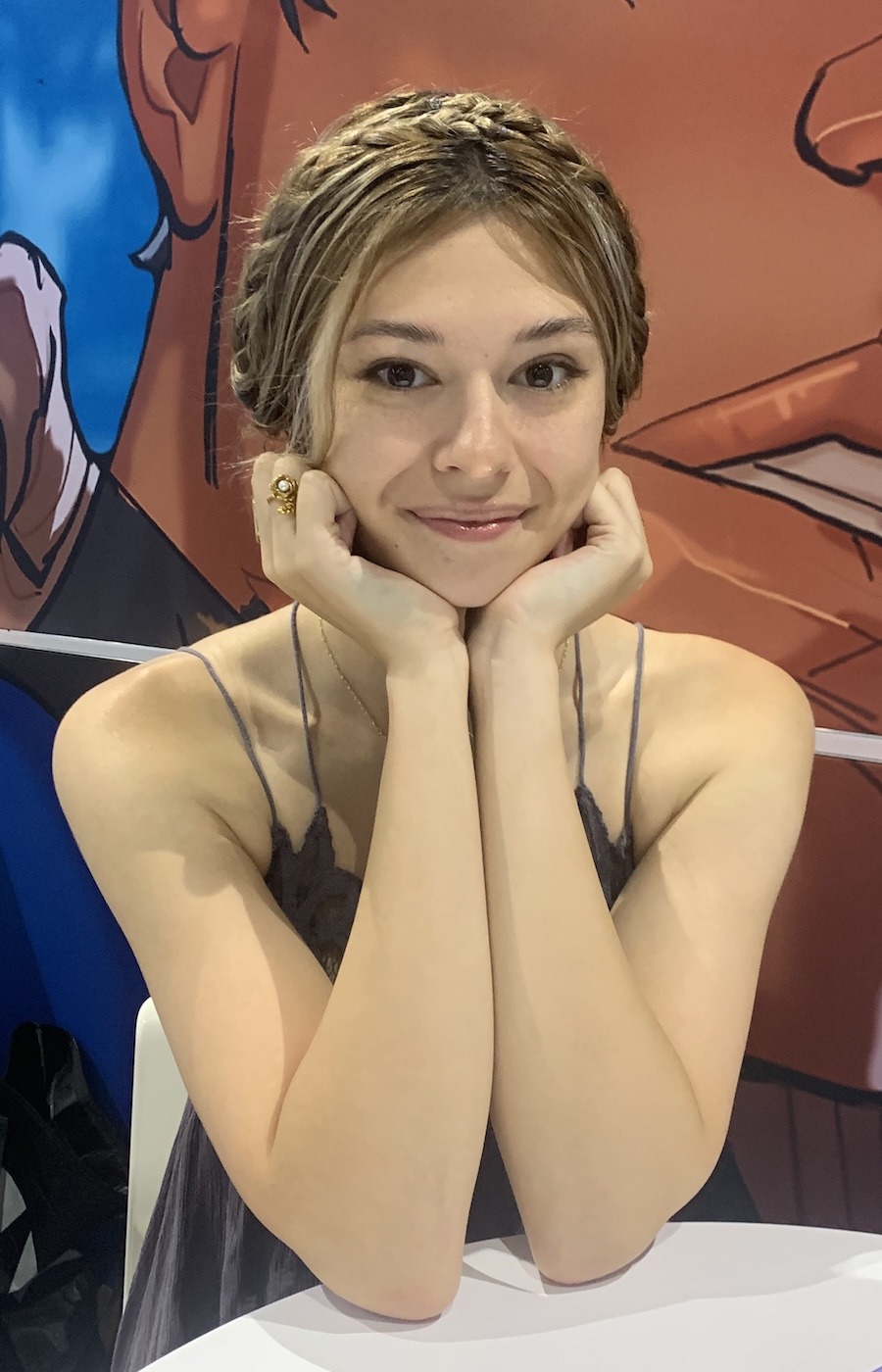
Going from actor to writer is a big jump. How did you do that?
That started when the Supergirl show was starting to come to an end. [Dreamer] is a character that means so much to so many people. I’ve never seen myself in a superhero like this before, and I wanted to make sure that she continued. So I talked to Renee Reiff, who was our DC correspondent on the show, and I said, “Would you be able to get me a meeting and I could pitch this idea that I have for a Dreamer ongoing series?”
DC was very generous and humored me, and they said, “We have this young adult line that we’re looking for new material for, and we don’t have yet a story about sisters. Would that be something?” I was like, “Oh, well, Dreamer famously has an asshole sister. I could write that story.” That’s how that started.
I did not go into that meeting expecting to come out with a writing assignment. I was kind of like, “Hey, I have this idea, you guys have the contacts, you’ll find a writer who is perfect for this. I just want to make sure it happens.” When they asked me if I would do it, I was like, “Okay, if the bar is that low, I’ll take a crack at it.” So I started working on Bad Dream. That conversation was in February 2020, and the book came out in April 2024, so I was working on that for four years. All the other comics I’ve written came after that, so that was actually the first thing I started, and that was happening in the background of all of my other comics.
Fiction writing isn’t easy, and comics writing is a specialized skill. How did you learn it?
Diego Lopez was my editor. She’s no longer at DC, but she was my editor on the first DC Pride special, and she gave me the crash course on comic book writing: every bit of terminology, this is how you format the pages, this is how it’s supposed to look, this is what the entire process looks like. It was a learning curve, for sure.
I’ve been very fortunate to have also worked with a lot of other writers like Tom Taylor and Steve Orlando, who are such good friends to me and are such good mentors. They give me such good advice and were always willing to proofread and give me ideas and nudge me when the page isn’t looking right. Talking to Jadzia Axelrod, who did Galaxy: The Prettiest Star—our phone calls are wild.
Bad Dream starts at a really interesting time, when Nia is just coming into her own, but it is not about her transition at all—that’s already happened. Why did you decide not to do a coming out story?
That story has been told so many times before. The way that we talk about trans people in popular culture and in media and in politics is as if there is one experience, and that’s so not the case. I wanted to tell a story that we hadn’t really seen before, or rather that maybe some audience hadn’t seen before, but that would still be very familiar to queer people in the queer community. That’s why I wanted to incorporate ballroom. I want to make sure that we are paying tribute to the lived reality of a lot of people and what kind of came out of that struggle and the culture that is born through our suffering and through our camaraderie.
When Nia runs away, she group of friends who are all very different from each other, but at the same time, they bond with her in a way that strikes me as being very much an aspect of the queer community, or at least some parts of the queer community, that people stick together.
I really wanted to show the importance of found family. Of course, Dreamer has her family, and she loves her mom and she loves her sister. She would do anything for her sister. But we can see the cracks. Nia was ready to go before all this happened; she had packed a to go bag. She was already thinking about this. Her home wasn’t the safest place for her. She didn’t really have anyone on her side. She was a supporting player in her own life. And going to Metropolis and meeting these girls, I want to show that sisterhood. I want to show that family has all of these different meanings, and there are different ways that you are a family. So many queer people have their second families, their found families, their chosen families that are more real than anything. And that’s really what I wanted to show and pay tribute to.
Writing for teens is really challenging, because they instantly know when they are being talked down to. How did you approach that?
You know, it’s so funny that you say that, because that was something that I was really thinking about as I was working on this. I remember being a queer teen growing up, when I was in the closet. I had to be—stealth was the term we used—for two years in middle school. During that time, my mom would try to give me books and stuff, just to say “You’re not alone.” I understand why she did that, and I appreciate it, but so much of the queer content that I would read did feel that way, sort of like we were being spoken down to, and it felt a little condescending.
ADVERTISEMENT
ADVERTISEMENT
I was like, “Do you think I’m six? I’m a teenager in America. I’m a trans teenager in America. I can handle some bullshit.” So that’s what I wanted to show in this book, to the point where my editor, Sarah, at a couple points, did have to remind me, “Okay, so this is a little violent. I don’t know if we can do that. That’s pretty brutal, Nicole,” and I was like, “These kids are doing active shooter drills. I don’t want to coddle them.” I want to speak to the truth of this while also offering—like, the Bottom Dollar Inn [a free hotel for the queer community]. That’s so not the reality for so many homeless queer kids, but I wanted to be like, maybe in the tradition of superheroes, wouldn’t it be something if you ran away from home and there was this beacon, this haven waiting for you of community and inclusion, where it’s a party and it’s nice and fun, and there’s pizza and ballroom and corgis.
We all want that!
Yeah, wouldn’t that be nice? So I wanted to do that, but then I also wanted to make sure that we’re still talking to the reality. That’s why there’s also that scene with Yvette where she’s saying “Before this, I was sleeping on the street because that was safer than going to the shelters where I would either be put in men’s housing or I try to go to women’s housing and be kicked out onto the street because, oh, they didn’t want the trans woman in there with them.” I wanted to make sure that we’re always being honest, because I don’t think it serves the community, the movement, or anything by not showcasing that, by trying to sugarcoat that.
Nia’s friends are a little rough around the edges.
We’re queer teens. We’re assholes to each other, and that’s how we show love. One of my favorite interactions in the book is when they get back to the hotel room after the ballroom scene and Yvette’s got her trophy and Nia, is just like, “Oh, my god, that’s amazing! I’ve never seen anything like that!” Yvette goes, “There’s something really special about people recognizing my brilliance for the first time,” and Kat says “You’re a psychopath.” That was flagged. They were like, “We don’t know if we can say that. We don’t want to be stigmatizing.” And I was like, “Look, this is how queer teens talk to each other. I don’t want to smooth the edges so much that it becomes unrecognizable. I’m telling these kids their own story. This is a story about them, for them, they are the stars of this. And real is always better.
The story doesn’t exactly have a happy ending. Why not?

For that same reason. I always knew Nia’s story was going to end with her mom dying and that being her fault, because that was such a crux of her character on Supergirl. It’s the guilt that she carries around and that carries us into Absolute Power and Suicide Squad Dream Team in the DC mainline, where her whole motivation is she’s able to be blackmailed because she doesn’t want to be the reason her family gets hurt again. You don’t really become a superhero because things are going great for you. It comes from trauma. So I thought that it wouldn’t feel true, if, after all that happens—she loses her sister, she finds out what her sister really thinks of her, she loses her mom, and she also gets beat up—and then I’m like, “Hey, but you know what, happy ending!” I thought of it more of like a beginning, a somber beginning, for Dreamer, and hopefully a little a little bit of hope. She’s gonna try to make things better.
Filed under: Graphic Novels, Interviews, Young Adult

About Brigid Alverson
Brigid Alverson, the editor of the Good Comics for Kids blog, has been reading comics since she was 4. She has an MFA in printmaking and has worked as a book editor, a newspaper reporter, and assistant to the mayor of a small city. In addition to editing GC4K, she is a regular columnist for SLJ, a contributing editor at ICv2, an editor at Smash Pages, and a writer for Publishers Weekly. Brigid is married to a physicist and has two daughters. She was a judge for the 2012 Eisner Awards.
ADVERTISEMENT
ADVERTISEMENT
SLJ Blog Network
Rebecca Stead’s EXPERIMENT
31 Days, 31 Lists: 2025 Books with a Message (Social & Emotional Learning)
From Policy Ask to Public Voice: Five Layers of Writing to Advance School Library Policy
Where Recipe Meets Magic, a guest post by Marisa Churchill
ADVERTISEMENT